
This article aims to examine the opportunities for 3D artists in the field of archaeology and artefact preservation, particularly through photogrammetry and reconstruction.
Art and rare items of cultural and historic importance face the constant threat of degradation and loss. With 3D scans and photogrammetry, historians can document and preserve digital copies of these artefacts that can be made accessible for research and other educational purposes. This also subsequently allows for possibilities such as 3D printing replicas, virtual tours, and ending controversies over the possession of heritage items (Johnson, 2025).
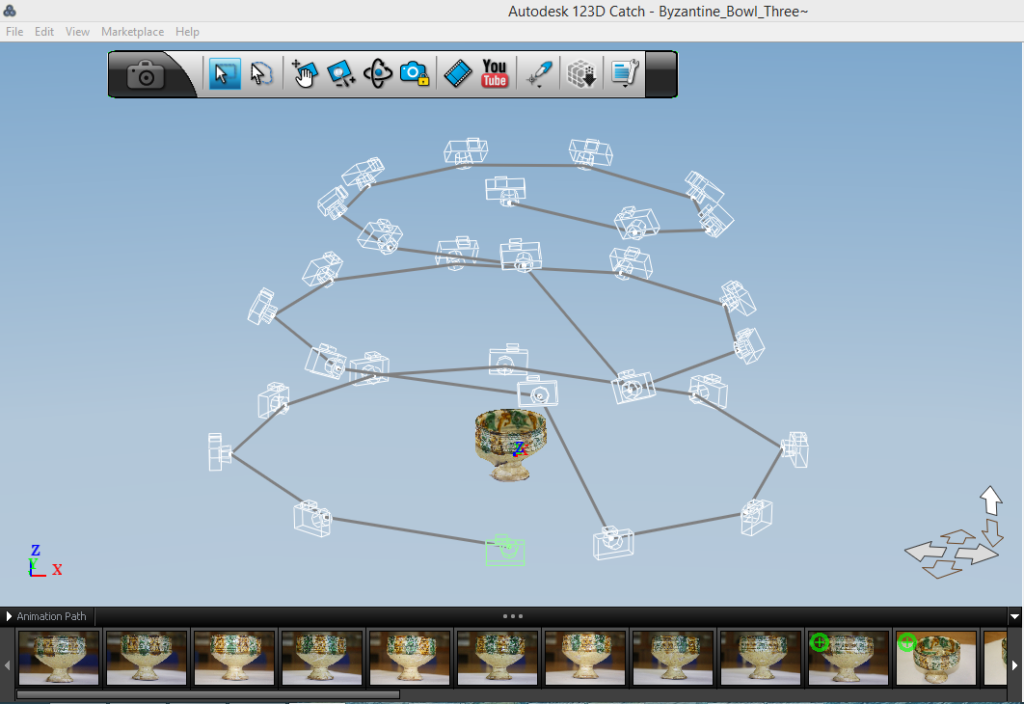
The basic workflow itself starts with creating a shooting plan and on-site photography of the subject. Corresponding points are then extracted from the numerous photographs and camera positions and the object’s shape is estimated to generate 3D data. Unnecessary parts are removed as needed and shadowed areas are checked to ensure they were captured correctly. The deliverables include not only the 3D model but also data such as shooting times, processing conditions, object descriptions and more so that the records can be reviewed by future handlers years or decades later (LRTK team, n.d.).
These digital preservation techniques have created a specialised niche for technical work. For instance, the Rae project involved documentation of 336 historic Scottish properties and 38,000 artefacts using photogrammetry, close-range laser scanning, and structured light scanning. Beyond reconstruction, strict data management was required to organise raw field photography, software-specific working files, and optimised deliverables and metadata into legacy institutional databases. The data was then used for 3D interactive models in gaming environments, to assess the condition of buildings and objects, display models on sketchfab, and more (Wilson, 2020).
Many organisations also commission third-party organisations or hire out of house rather than training staff for such surveys. Accompanying field data required such as survey control and photography, and the processing of data that requires skills and software that extend into 3D modelling, animation, and presentation also present opportunities for 3D artists (Historic England, 2018). For example, scans are often dense models that must be optimised and retopologised by 3D artists using tools like 3DCoat, Zbrush, or Maya before use in real-time applications, web applications, and virtual environments (Robinson, n.d.).
This commercial demand can also be seen in contractors such as Wessex Archaeology (n.d.) which employs teams of professional artists who work with specialists to reconstruct archaeological remains in the form of traditional hand drawings and watercolours, digital paintings, animations, 3D reconstructions, and 3D prints.
The shift towards photogrammetric preservation has opened doors for 3D artists and technical work in a completely new setting. In addition to using advanced 3D technology to record cultural heritage digitally, applying it practically or transforming it into interactive media calls for 3D specialist skills that are not found within the archaeological field itself.
References
Historic England. (2018). 3D laser scanning for heritage advice and guidance on the use of laser scanning in archaeology and architecture. In Iluminet (p. 45). Historic England. https://iluminet.com/newpress/wp-content/uploads/2019/03/heag155-3d-laser-scanning.pdf
Johnson, A. (2025, November 28). Photogrammetry for the preservation of art and rare items. AccuPixel Ltd. https://accupixel.co.uk/2025/11/28/photogrammetry-for-the-preservation-of-art/
LRTK team. (n.d.). 7 use cases of photogrammetry for cultural heritage. Lefixea. Retrieved May 6, 2026, from https://www.lefixea.com/article/culturalassets_photogrammetry2
Mirashrafi, S. (2015). Screenshot of 123D catch [Online Image]. In St. Andrew’s Classics. https://standrewsclassics.wordpress.com/2015/09/30/photogrammetry-and-3d-imaging-bridges-collection-123d-catch/
Robinson, M. (n.d.). Mesh retopology in 3D modeling – explained. MYND Workshop. Retrieved May 6, 2026, from https://myndworkshop.com/resources/what-is-mesh-retopology
Wessex Archaeology. (n.d.). Reconstruction & Visualisation. Wessex Archaeology. Retrieved May 6, 2026, from https://www.wessexarch.co.uk/reconstruction-visualisation
Wilson, L. (2020, May 4). Recording Scotland’s history with the Rae project. Historic Environment Scotland Blog. https://blog.historicenvironment.scot/2020/05/recording-scotlands-history-in-3d-with-the-rae-project/